
Secure Session Workflows with AWS KMS-Signed JWTs (JWS)

Setting the scene
How do you trust a client’s session during upload without re-running expensive validation logic or exposing yourself to tampering?
In this post, we’ll walk through a production-grade pattern using:
- Short-lived signed JWTs (JWS)
- AWS KMS for signing & verification
- A token chaining model that enforces trust across steps
The Goal
We wanted to guarantee:
- A session is validated exactly once
- Uploads are cryptographically bound to that validation
- No reliance on:
- Long-lived credentials
- Re-validating session ownership on every request
The Problem
Our session lifecycle has two phases:
1. Validation
Client proves ownership of a key and receives:
- Session state
- Progress info
2. Upload
Client submits gameplay events tied to that session
The Naive Approach
POST /upload_session

→ Accept key + session_key

→ Re-run validation logic or accept the data
Why this fails:
- Tight coupling between upload & validation
- Now the upload service must answer questions like:
- Does this session belong to this key?
- Was the session already validated?
- Is the session still active?
- Was it already completed?
- Vulnerable to session key substitution
- If the backend only checks:
- “Does this session exist?” => Then uploads may be accepted for the wrong session.
- Easy to accept events for unauthorized sessions
- Without a signed validation token, the upload endpoint has no proof that:
- Validation actually happened
- The session was approved
- The uploader is authorized for that session
- Example
1. Client validates Session A
2. Client modifies request
3. Uploads events for Session B
4. Server accepts upload
The Key Idea
“If validation already proved this session is valid — just sign that fact.”
Instead of re-validating:
- Issue a signed token after validation
- Require that token for upload
The Token Chain Architecture
We introduce three endpoints and two token types:
High-Level Flow
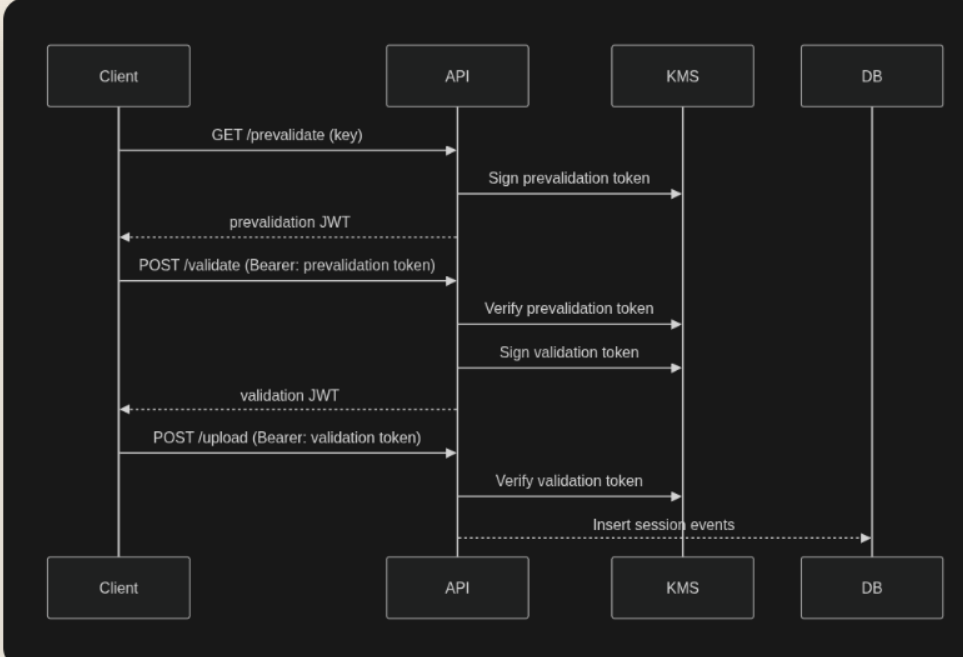
Step-by-Step Breakdown
1) GET /prevalidate/key:key
Purpose
- Validate the key
- Return session state only (no session creation)
Output
A prevalidation token
Example Claims
{
  "key": "k_abc123",
  "sessionStatus": "NotStarted" | "Started" | "Completed",
  "timestamp": "2024-01-15T10:00:00Z"
}
2) POST /validate
Input
- Bearer token: prevalidation JWT
What happens
- Verify token via KMS
- Enforce token type (cty = prevalidation)
- Run validation logic
- Create or resume session
Output
A session token
{
  "sessionKey": "sk_xyz789",
  "key": "kk_abc123",
  "timestamp": "2024-01-15T10:01:00Z"
}
3) POST /upload_session
Input
- Bearer token: validation JWT
What happens
- Verify token via KMS
- Extract sessionKey from token
- Insert events using that key
Request Example
{
  "key": "kk_abc123",
  "session_events": {
    "data": [
      ...
    ]
  }
}
Token Design
Two Token Types
Property | Prevalidation | Validation |
cty | prevalidation | validation |
sessionKey | Optional | Required |
Used by | validate | upload |
JWT Structure
Header:  { "alg": "RS256", "kid": "<kms-key-id>", "cty": "session" }

Payload: { ...claims, "iat": ..., "exp": ... }
Signing Flow
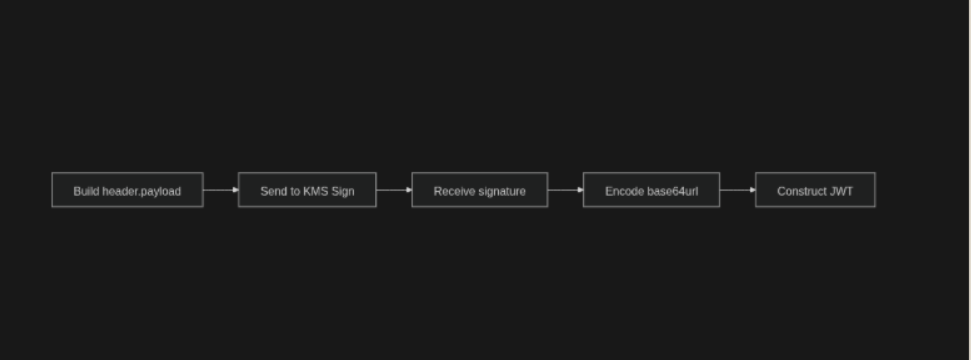
We use:
- RSA asymmetric key
- Algorithm: RSASSA_PKCS1_V1_5_SHA_256 (→ JWT RS256)
Flow
- Build header.payload
- Send to KMS Sign
- Encode signature
- Construct final JWT
private def signString(keyId: String, unsignedString: String): App[String] =
  RIO.ask[Env].mapIO { env =>
    IO.fromCompletableFuture(IO(
      env.kmsClient.sign(
        SignRequest.builder()
          .keyId(keyId)
          .message(SdkBytes.fromUtf8String(unsignedString))   .signingAlgorithm(SigningAlgorithmSpec.RSASSA_PKCS1_V1_5_SHA_256)
          .build()
      ))).map(_.signature())
       .map(sdkBytes => JwtBase64.encodeString(sdkBytes.asByteArray()))
  }
Verification with AWS KMS
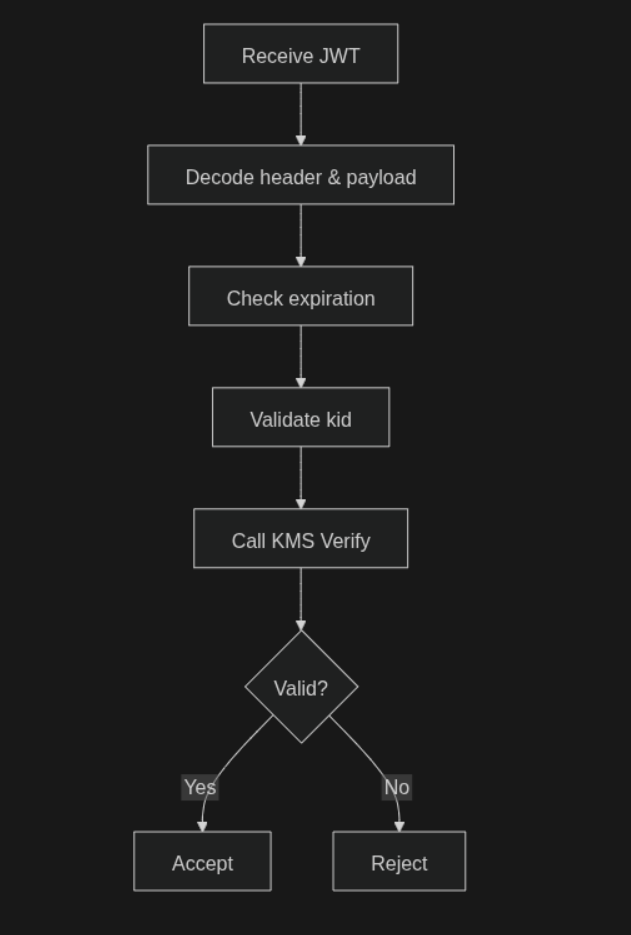
Steps:
- Decode JWT (skip signature, enforce expiration)
- Validate kid
- Call KMS Verify
- Parse claims by cty
private def verifyWithKms(keyId: String, signedSessionString: String, signature: String): App[Unit] =
  RIO.ask[Env].mapIO { env =>
    val unsignedTokenString = signedSessionString.substring(0, signedSessionString.lastIndexOf('.'))
    IO.fromCompletableFuture(IO(
      env.kmsClient.verify(
        VerifyRequest.builder()
          .keyId(keyId)
          .message(SdkBytes.fromUtf8String(unsignedTokenString))
    .signature(SdkBytes.fromByteArray(JwtBase64.decode(signature)))  .signingAlgorithm(SigningAlgorithmSpec.RSASSA_PKCS1_V1_5_SHA_256)
          .build()
      )
    )).flatMap { vr =>
      if (vr.signatureValid().booleanValue()) IO.unit
      else IO.raiseError(InvalidSessionVerification("The token did not pass signature verification"))

    }

  }
Error Handling
{
  "result": "failure",
  "code": 1043,
  "message": "Error authenticating session token"
}
| Code | Meaning |
| ---- | ---------------- |
| 1043 | Invalid token |
| 1017 | Key expired |
| 1011 | Key not found |
| 1041 | Duplicate upload |
| 1042 | Session locked |
| 1044 | Wrong type of token |
Final Architecture Insight

Why This Pattern Works
- Eliminates re-validation overhead
- Prevents session tampering
- Cryptographic guarantees
- Scales cleanly across services
Summary
- Validation happens once
- Trust is enforced via signed tokens
- Upload becomes:
- Stateless
- Fast
- Secure


Comments